


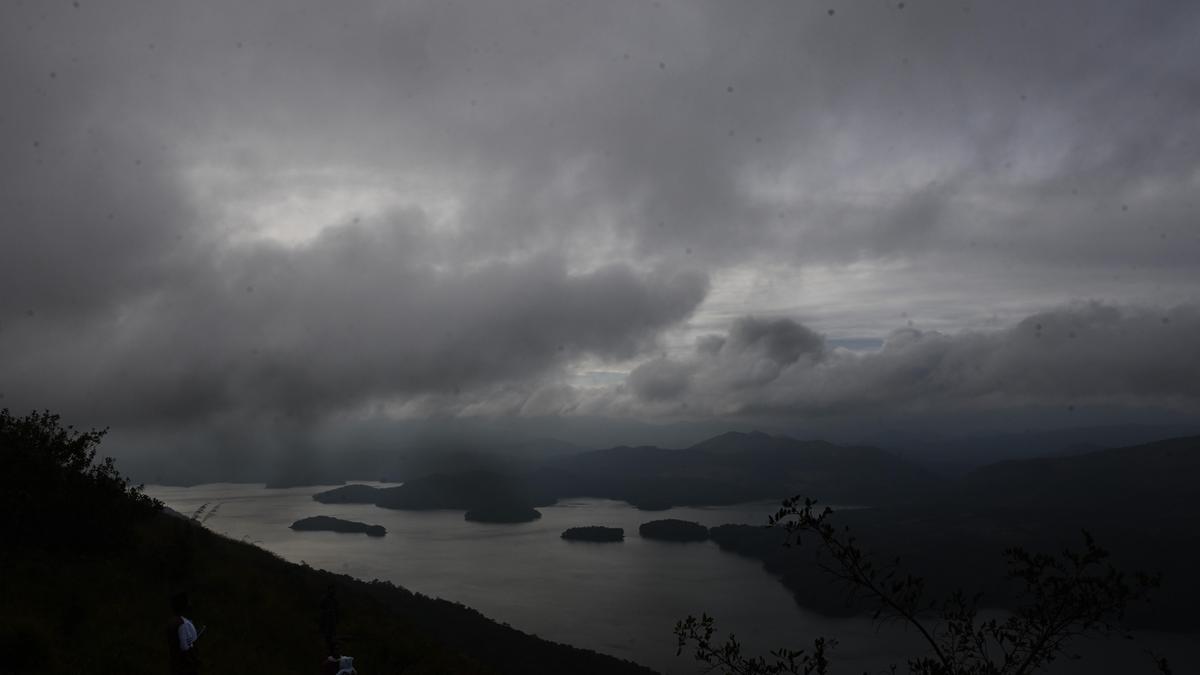
Image used for representation purpose only.
| Photo Credit: The Hindu
The southwest monsoon is expected to advance into Kerala on May 26, the India Meteorological Department (MD) said on Friday (May 15, 2026). The ‘normal’ date for the monsoon’s advent over the State is June 1.
The monsoon has nearly arrived over the Andaman and Nicobar Islands and the Bay of Bengal, the IMD said in a press statement. From here, it is typically a 10-day journey onto mainland India though there can be various factors — such as a fomenting cyclone — that can impede this development.

Last year, the monsoon set in over Kerala on May 24 — its earliest arrival since 2009. Though the date of arrival does not correlate with the quantum of rainfall, the latter is a cause of concern this year with the IMD and other weather agencies having warned of ‘below normal’ rainfall.
IMD’s operational forecasts of the date of monsoon onset over Kerala during the past 21 years (2005-2025) were proved to be correct except in 2015, the agency said in a fact sheet. ‘Correct’ here means the monsoon arriving in a window of four days of the forecast date.
The IMD has an elaborate criteria for declaring the monsoon’s onset over Kerala that includes a minimum number of meteorological stations spanning Kerala and parts of Karnataka registering a prescribed quantity of rain, wind speed and cloud density exceeding a certain threshold.
“What we know so far is that after the monsoon onset, there will be a good amount of rain for the next five days after. The subsequent progress and advance can only be reliably known after the [forecasting] models are run subsequently,” M. Ravichandran, Secretary, Ministry of Earth Sciences, told The Hindu.
India last experienced reduced monsoon rainfall in 2023 — when the IMD had warned of ‘near normal’ rainfall at 96% of the long period average (LPA) — but in 2015, the IMD’s warning of below normal rain, at 93% of the LPA, ended up being an overestimate with the actual rainfall being only 86% of the LPA, leading to one of India’s worst drought years.
The main reason for this is the likely development of an El Nino — a periodic warming of the central equatorial Pacific that in the 16 years it has emerged since 1950 has depressed India’s monsoon rainfall nine times.
With disruptions of fertilizer supply ahead of the kharif season anticipated in the wake of the West Asia war, insufficient rain could impact farming which is significantly rainfed.
Published – May 15, 2026 02:39 pm IST



