


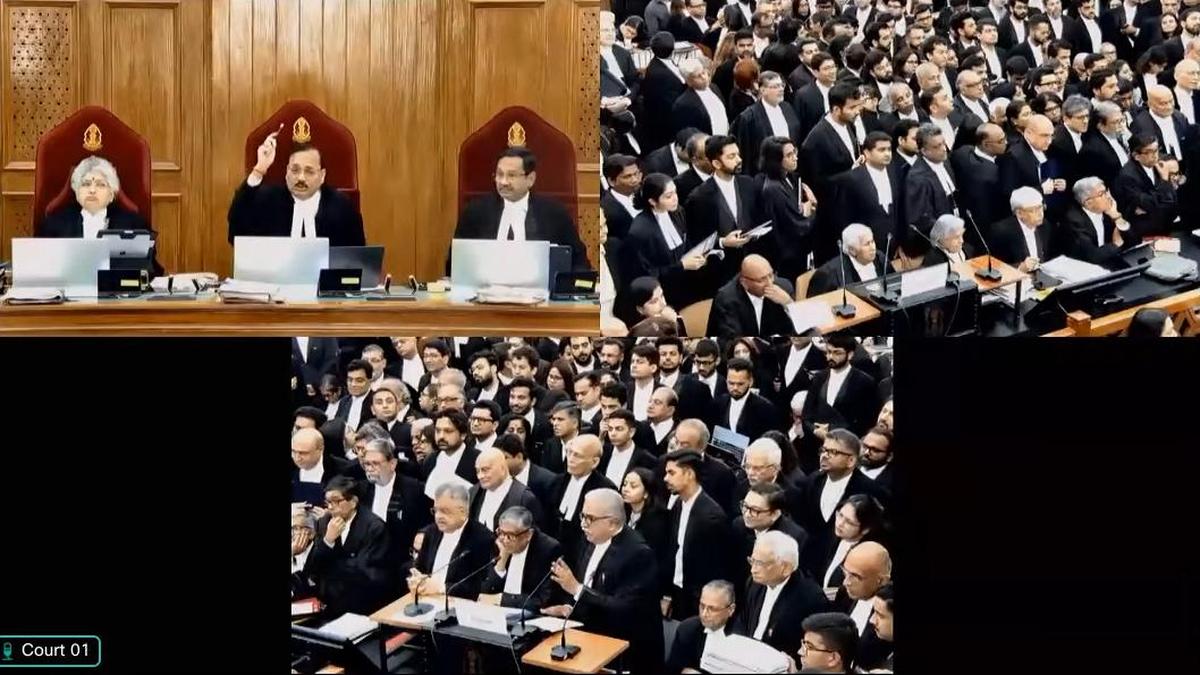
Supreme Court nine-judge Bench hearing led by Chief Justice of India (CJI) Surya Kant underway in the long-pending Sabarimala temple entry review, along with a batch of connected matters, in New Delhi on Tuesday, April 7, 2026. Photo credit: Supreme Court YT via ANI
Women cannot be treated as ‘untouchables’ selectively for three days a month, the Supreme Court observed on Tuesday (April 7, 2026).
Justice B.V. Nagarathna’s remarks came against the backdrop of submissions referring to the erstwhile prohibition on menstruating women, barring them from entry into the Sabarimala temple. A 2018 judgment by the Supreme Court had lifted the centuries’ old prohibition on entry to the famed Kerala shrine by women in the years between menarche and menopause. The court had said the prohibition reduced freedom of religion to a “dead letter” and was a smear on the individual dignity of women.

“Speaking as a woman, I can say there cannot be untouchability practised for three days every month, and no untouchability on the fourth day. Let us go by hard realities. Speaking as a woman, Article 17 (abolition of untouchability) cannot apply for three days and on the fourth day there is no untouchability,” Justice Nagarathna emphasised while addressing the Union government, represented by Solicitor General Tushar Mehta.
SC likened Sabarimala prohibition to untouchability
The Centre expressed strong reservations against the 2018 Sabarimala judgment comparing the bar on women’s entry into the temple to the practice of untouchability.
The comparison of the temple prohibition to the practice of untouchability had been made by Justice D.Y. Chandrachud (now retired), in his separate opinion which formed part of the 2018 Sabarimala majority judgment. Justice Chandrachud had termed the social exclusion of women, based on menstrual status, a “form of untouchability,” saying that notions of “purity and pollution” stigmatise individuals. To exclude women was derogatory to an equal citizenship, he had observed in his opinion.
“India has always treated women not only equally but on a higher pedestal. We are uniquely the only culture which bow down to women deities. But there are several recent judgments which accuse us of patriarchy, gender stereotyping… it was never there. We worship ladies. From the President of India to the judges of the Supreme Court, we bow down before our lady deities… India is not as patriarchal or gender-stereotyped as the West understands,” Mr. Mehta submitted on Tuesday (April 7, 2026).
‘Respect denominational practices’
Mr. Mehta said the prohibition was not for three or four days, but was for an age group, adding that the prohibition was sui generis (unique) to the Sabarimala shrine. Other Lord Ayyappa temples, globally, were accessible to women of all ages, he said.
“There are denominational practices which we need to respect. Everything is not down to human dignity and individual autonomy… It is also about respecting the faith and tenets of a religion, not everything is about the taking away of dignity or bodily autonomy… Fundamental rights cannot be islands,” Mr. Mehta said.
The decision of a particular religious denomination to regulate the entry of a section of society to a specific religious institution must be protected as a denominational right, the Centre said. Courts could very well intervene to strike a balance between civil rights and religious denominational rights if a blanket ban was imposed on entry against an entire class of individuals in all religious institutions.
‘Man’s celibacy cannot be woman’s burden’
In his opinion eight years ago, Justice Chandrachud had written that treating women as the children of a lesser God due to their natural biological attributes was to blink at the Constitution.
Justice Chandrachud had dismissed the argument that the prohibition was in keeping with the form of the deity and the vow of celibacy by followers.
“Such a claim imposes the burden of a man’s celibacy on a woman and constructs her as a cause for deviation from celibacy. This is then employed to deny access to spaces to which women are equally entitled,” Justice Chandrachud had rationalised.
Published – April 07, 2026 10:27 pm IST



