

By using this site, you agree to the Privacy Policy and Terms of Use.
Accept
India Times NowIndia Times NowIndia Times Now
Notification Show More
Font ResizerAa
  • India News
    India News
    Politics is the art of looking for trouble, finding it everywhere, diagnosing it incorrectly and applying the wrong remedies.
    Show More
    Top News
    The States Braces for Protests Over New COVID Rules
    August 29, 2021
    JD(S) will never sever ties with NDA, declares Deve Gowda
    November 22, 2025
    Noida techie death: The road that ended in a tragedy
    January 26, 2026
    Latest News
    Eight from Karnataka killed in a road accident near Mantralayam
    April 16, 2026
    Need for joint response of INDIA bloc on delimitation, women reservation bills: Omar Abdullah
    April 16, 2026
    Women’s Commission sets up panel to probe alleged sexual harassment at TCS Nashik
    April 15, 2026
    Chhattisgarh cabinet forms committee to prepare UCC draft
    April 15, 2026
  • Technology
    TechnologyShow More
    Strengthening the Team: Thryve PR Onboards Pranjal Patil as PR Executive & Project Manager
    October 1, 2025
    How to Take the Perfect Instagram Selfie: Dos & Don’ts
    October 1, 2021
    Apple iMac M1 Review: the All-In-One for Almost Everyone
    Hands-On With the iPhone 13, Pro, Max, and Mini
    September 4, 2021
    Apple VS Samsung– Can a Good Smartwatch Save Your Life?
    August 30, 2021
  • Posts
    • Post Layouts
      • Standard 1
      • Standard 2
      • Standard 3
      • Standard 4
      • Standard 5
      • Standard 6
      • Standard 7
      • Standard 8
      • No Featured
    • Gallery Layouts
      • Layout 1
      • Layout 2
      • layout 3
    • Video Layouts
      • Layout 1
      • Layout 2
      • Layout 3
      • Layout 4
    • Audio Layouts
      • Layout 1
      • Layout 2
      • Layout 3
      • Layout 4
    • Post Sidebar
      • Right Sidebar
      • Left Sidebar
      • No Sidebar
    • Review
      • Stars
      • Scores
      • User Rating
    • Content Features
      • Inline Mailchimp
      • Highlight Shares
      • Print Post
      • Inline Related
      • Source/Via Tag
      • Reading Indicator
      • Content Size Resizer
    • Break Page Selection
    • Table of Contents
      • Full Width
      • Left Side
    • Reaction Post
  • Pages
    • Blog Index
    • Contact US
    • Search Page
    • 404 Page
    • Customize Interests
    • My Bookmarks
  • Join Us
Reading: ‘Making justice accessible requires a systemic approach beyond formal equality‘
Share
Font ResizerAa
India Times NowIndia Times Now
  • Finance ₹
  • India News
  • The Escapist
  • Entertainment
  • Science
  • Technology
  • Insider
Search
  • Home
    • India Times Now
    • Home 2
    • Home 3
    • Home 4
    • Home 5
  • Categories
    • Technology
    • Entertainment
    • The Escapist
    • Insider
    • Finance ₹
    • India News
    • Science
    • Health
  • Bookmarks
    • Customize Interests
    • My Bookmarks
  • More Foxiz
    • Blog Index
    • Sitemap
Have an existing account? Sign In
Follow US
Home » Blog » ‘Making justice accessible requires a systemic approach beyond formal equality‘
India News

‘Making justice accessible requires a systemic approach beyond formal equality‘

Times Desk
Last updated: February 28, 2026 6:12 pm
Times Desk
Published: February 28, 2026
Share
SHARE


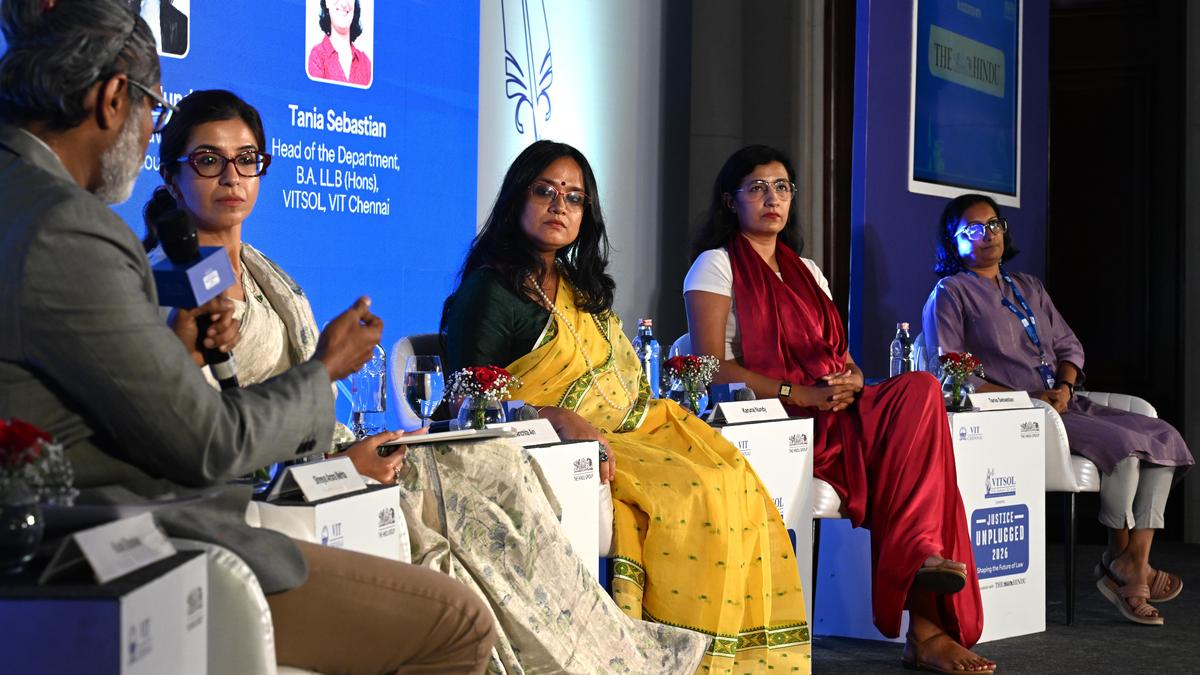
(From left to right) Kunal Shankar, Deputy Business Editor, The Hindu,  Shreya Arora Mehta, Dist & Addl Sessions Judge, Delhi, Sanchita Ain, Advovate on Records Supreme Court, Karuna Nundy, Sr. Advocate Supreme Court, Tania Sebastian, HoD BA LLB (Hons) VIT Chennai at The Hindu Justice Unplugged 2026 in New Delhi on February 28, 2026.

(From left to right) Kunal Shankar, Deputy Business Editor, The Hindu, Shreya Arora Mehta, Dist & Addl Sessions Judge, Delhi, Sanchita Ain, Advovate on Records Supreme Court, Karuna Nundy, Sr. Advocate Supreme Court, Tania Sebastian, HoD BA LLB (Hons) VIT Chennai at The Hindu Justice Unplugged 2026 in New Delhi on February 28, 2026.
| Photo Credit: R.V. Moorthy


For Sanchita Ain, Advocate-on-Record at the Supreme Court, the struggle for access to justice began with her own right to practise law. 

“I myself have a disability — a chronic neurological condition — and at one point I believed I was unfit for litigation because I could not work the long hours the profession demands,” she said. “What made the difference was accommodation — not sympathy, but institutional accommodation. If systems are not put in place, inclusion depends on individual goodwill.” 

Speaking at Justice Unplugged 2026, a daylong legal conclave, Ms. Ain recounted how she had to repeatedly push the Supreme Court administration to provide a sign language interpreter for Sarah Sunny, a lawyer with hearing disability she represented in September 2023. “She did not need permission for an interpreter. It was her right,” she said, pointing to persistent “court bureaucracy” that forces litigants and lawyers with disabilities to “run from pillar to post”. 

Moderating the discussion, Kunal Shankar, Deputy Business Editor, The Hindu, framed the broader structural question: whether greater representation on the Bench — across gender, caste, disability and other identities — could meaningfully expand access to justice. He noted that empirical studies have repeatedly pointed to the under-representation of marginalised communities in higher judicial appointments, and asked whether reform of the appointments process was integral to improving access. 

Karuna Nundy, Senior Advocate, Supreme Court, responded by turning the focus to diversity within the judiciary. “What is the essential problem with having mostly upper-caste, able-bodied men as judges across the board?” she asked. “Representation is a good in and of itself. It must not be that if you are a woman, or Dalit, or queer person, you must be 10 times more brilliant than the next person to deserve a place.” 

On the collegium system, she argued that structural reform — including forms of reservation — must be seriously debated to address historical exclusion. Speaking about the designation as Senior Advocate, she noted that increased transparency — requiring candidates to disclose constitutional matters argued, pro bono work undertaken and academic contributions — had made the process “that much more objective”, even if discretion and bias can never be entirely eliminated. 

Shreya Arora Mehta, District and Additional Sessions Judge, Delhi, reflected on the evolution of judicial infrastructure and legal aid. “When I joined the judiciary in 2010, judges would hope their courtroom at least had an attached washroom. Our seniors told us they had worked in courtrooms without even proper lighting,” she said, underscoring gradual but uneven improvement. 

On legal aid, she was candid about quality concerns. Recounting an interview with a young lawyer who could not answer basic procedural questions but said he would “learn on the job”, she observed: “You are going to learn at the cost of the deprived. Legal aid is about dignity. We cannot experiment with the cases of the vulnerable.” While India remains a global leader in statutory, court-annexed legal services, she stressed that mentoring and monitoring mechanisms must strengthen quality across the country. 

Dr. Tanya Sebastian of VIT School of Law brought the conversation back to legal education. “Access to justice begins with access to legal education,” she said, highlighting tuition barriers, mental health challenges and questions of gender identity faced by students. Clinical legal education, she added, enables students to engage with communities and treat justice delivery as a systemic problem, not merely a courtroom exercise. 

The session closed with questions from students and lawyers on constitutional morality and accessibility for persons with disabilities. If one theme ran through the discussion, it was that equality before the law is only a starting point. As Ms. Ain put it, “Justice is not just about dispute resolution. It is about creating a structure where every person can participate in all aspects of life with dignity.” 

Published – February 28, 2026 11:42 pm IST


Source link

‘A double-engine govt. will de-risk people from political conflicts that hurt their development’: Rajeev Chandrasekhar
No power tariff hike for consumers in Andhra Pradesh for 2026-27 financial year
West Asia flight disruption through Kochi airport enters third day; taxi drivers bear brunt of cancellations
Karnataka plans integrated Cyber Command Centre with AI-driven policing
Watch: Parliament clears Bill to allow 100% FDI in insurance sector
TAGGED:India judiciaryIndia lawyersJustice Unplugged 2026the hindu justice unplugged 2026
Share This Article
Facebook Email Print
Leave a Comment

Leave a Reply Cancel reply

Your email address will not be published. Required fields are marked *

Follow US

Find US on Social Medias
FacebookLike
XFollow
YoutubeSubscribe
TelegramFollow

Weekly Newsletter

Subscribe to our newsletter to get our newest articles instantly!
[mc4wp_form]
Popular News

India, Ethiopia natural partners in regional peace, security, connectivity: PM Modi

Times Desk
Times Desk
December 17, 2025
Chief Minister M.K. Stalin presents awards to weavers and designers, launches temple projects
SVIMS ‘Pink Bus’ screens 42,000 rural women for cancer
Activists urge Forest department to end unnecessary capture of wild animals
Rakesh Bedi: How Dhurandhar’s Jameel Jamali rocked small screen in 90s-20s
- Advertisement -
Ad imageAd image
Global Coronavirus Cases

Confirmed

0

Death

0

More Information:Covid-19 Statistics
© INDIA TIMES NOW 2026 . All Rights Reserved.
Welcome Back!

Sign in to your account

Username or Email Address
Password

Lost your password?

