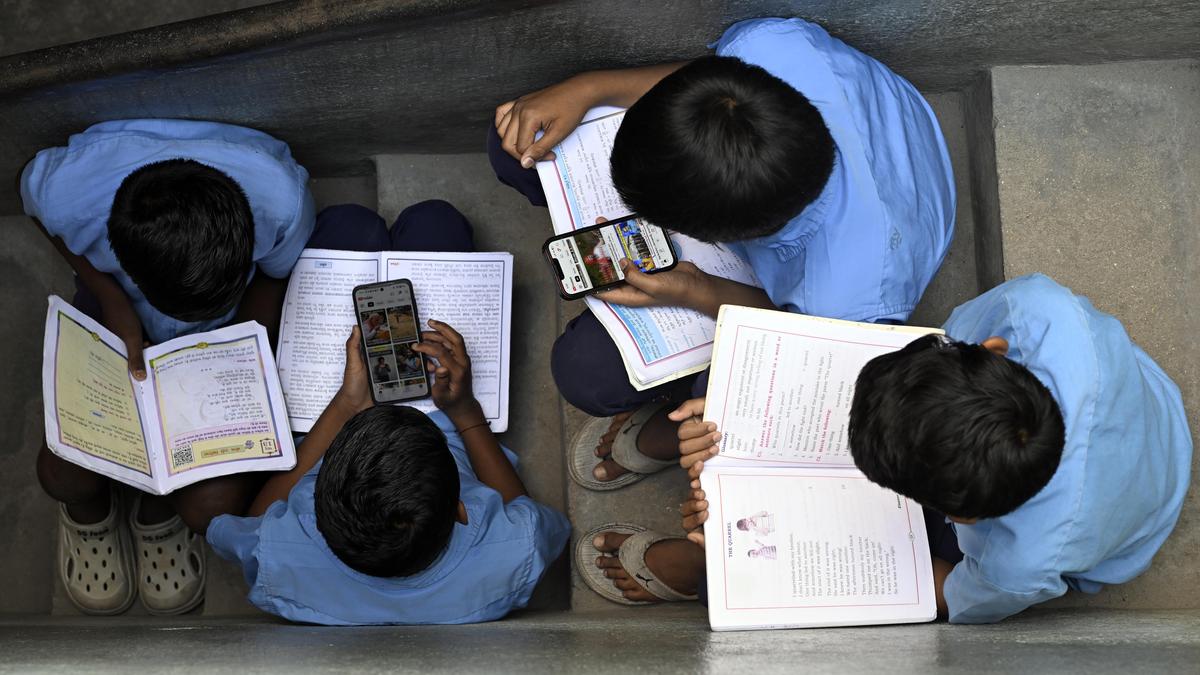
Several students say they are strongly opposed to the idea of a blanket ban, arguing that the internet plays a significant role not only in their learning but also in ‘self-expression’.
| Photo Credit: SUDHAKARA JAIN
As the Karnataka government weighs the pros and cons of restricting mobile phone use for children under 16, the proposal has raised questions about what exactly could be restricted, how it could be enforced, and whether a “blanket” ban could prove disadvantageous to certain groups of students.
While Chief Minister Siddaramaiah has flagged concerns over rising screen dependency, experts and parents remain divided on whether prohibition, regulation or guided usage would be the more practical path forward.
Students The Hindu interacted with acknowledged that mobile phones have become deeply embedded in their learning process. “Timetables and daily notes are usually shared in groups. In class, teachers explain concepts, but notes and materials are sent on WhatsApp,” said Maithali Kumari, a class 6 student from a private school in Cambridge Layout, Halasuru. She added that teachers often share YouTube links to further explain topics, making phone access almost unavoidable for academic purposes.
Several students said they were strongly opposed to the idea of a blanket ban, arguing that the internet plays a significant role not only in their learning but also in “self-expression”.
Some also pointed out that social media has improved their confidence and communication skills. “I enjoy being online because it gives me a sense of freedom. I feel more comfortable expressing myself there. In school, there’s always some pressure to fit in,” said Deepak K., a class 8 student at a private school in Rajajinagar.
Parents raise concerns
Parents, however, highlighted that phone-based engagement linked to schooling has increased significantly after the Covid-19 pandemic, when online classes were introduced, and has since continued.
Guru Reddy, parent of a 13-year-old, argued that the government must first frame clear guidelines in consultation with schools, as schools have integrated phones into routine communication. He pointed out that teachers create messaging groups for their classes and updates, leading students to demand personal mobile phones.
“In many cases, children are getting exposed to content that affects their well-being. They are becoming addicted to gaming and spending most of their time on phones,” he said. Schools, he added, circulate everything, from attendance updates and assignments, to leave and events, through WhatsApp groups. “This constant flow of updates even after school hours is not necessary. Children need time to focus on other skills and activities,” he said.
Beyond a ban
Development educationist Niranjanaradhya V.P. said that if the government was considering a “ban” on mobile phones, there must first be clarity on what was being restricted, for how long, and for what reason. He stressed that such a move requires informed deliberation rather than an immediate response.
Mr. Niranjanaradhya, who was part of the committee that submitted its recommendations to the Chief Minister, said the key suggestion was to constitute a high-level committee to examine the issue from multiple perspectives.
He highlighted that technology use was only set to increase and that a decision taken in isolation could widen the urban-rural divide. While children in cities may have access to laptops and tablets at home, many students in rural areas depend solely on mobile phones to access digital content, he pointed out. A blanket ban could disproportionately affect those who already have limited access to technology.
Manoj Sharma, head of the SHUT (Service for Healthy Use of Technology) Clinic at NIMHANS, said that rather than viewing technology as inherently harmful, stakeholders must understand “how much is too much”. With proper guidance and boundaries, he said, technology can be used in healthy ways.
Shashi Kumar D., general secretary of the Associated Managements of Primary and Secondary Schools in Karnataka (KAMS), called for a Standard Operating Procedure (SOP)-based approach that balances child protection with the realities of digital integration in education. He proposed the introduction of a government-regulated “Student Internet Pack” that would allow access only to approved educational websites during school hours.
Published – February 23, 2026 10:28 pm IST