

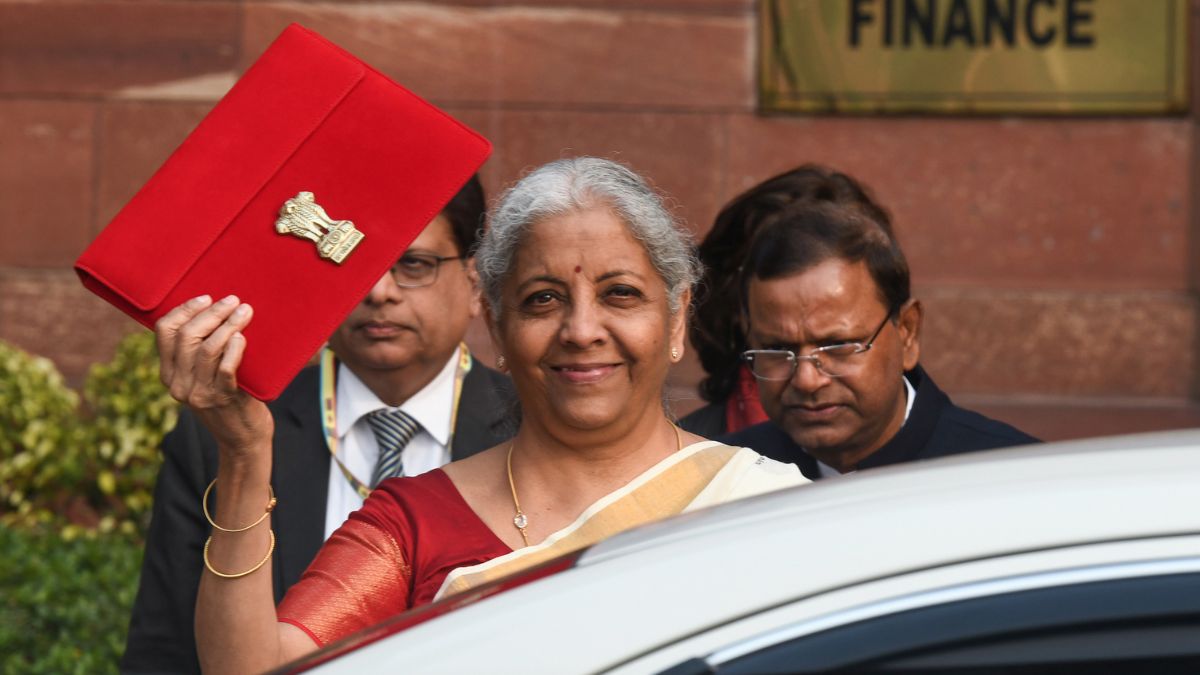

Union Budget 2026-27: The challenge in front of the government is also to restore the faith of the investors due to uncertainty over the trade deal between India and the US, which has unsettled the financial market.
Union Finance Minister Nirmala Sitharaman will present the Union Budget 2026-27 on February 1 (Sunday, a first in independent India’s history). This will be the ninth straight time Sitharaman will present the budget. The budget is being presented at a time of geopolitical tensions, global trade frictions and sweeping tariffs imposed by US President Donald Trump on India for buying Russian crude.
Last year, Sitharaman had announced reforms in the Goods and Service Tax (GST), termed GST 2.0, and sweeping income tax. Along with the interest reductions by the Reserve Bank of India (RBI), this helped the Indian economy to remain on track despite the 50 per cent tariffs imposed by the United States (US). However, the government is once again facing pressure to boost consumption and accelerate job creation.
The challenge in front of the government is also to restore the faith of the investors due to uncertainty over the trade deal between India and the US, which has unsettled the financial market, according to economists. They believe that Sitharaman may turn to petrol and diesel again, hiking the excise duty to increase the government’s revenues.
She may even announce packages for West Bengal, Tamil Nadu, Kerala, Assam and the union territory (UT) of Puducherry, where assembly elections are scheduled to be held this year.
Focus on capex to continue
The government will continue to focus on capital expenditure. Experts believe that the Centre may hike the budget for capex, particularly on priority areas like the railways, renewable energy, power transmission, defence and urban transport.
“We expect modest growth in tax revenue and flat growth in non-tax revenue,” news agency PTI quoted economists at SBI Research as saying. “Government capex may cross Rs 12 lakh crore in FY27, a YoY growth of around 10 per cent.”
Tax stability
It is unlikely that the government will give major tax cuts. Experts feel that tweaks in personal tax will likely be incremental to support the middleclass. However, for corporate tax rates will unlikely be changed.
“We expect Budget measures to align with the economy’s strategic ambitions, including on manufacturing and social welfare,” PTI quoted Radhik Rao, Senior Economist, DBS Bank as saying.
MSMEs and jobs
The government will also continue to focus on the MSME sector and job creation opportunities. It may even announce incentives linked to labour-intensive manufacturing, skilling and apprenticeships. Besides, there may also be refinements to production-linked incentive (PLI) schemes.
Green transition, energy security
Sitharaman will likely announce support for renewable energy, green hydrogen, battery storage and electric mobility, as the Centre continues focusing on energy-transition. Allocations for oil and gas infrastructure and strategic reserves could also be maintained to ensure energy security for India amid the continued global uncertainty.



