


Between January and February 2026, the banks of the Bharathapuzha at Thirunavaya in Malappuram district of Kerala become a pilgrimage hub for the Maha Magha Mahotsavam. Ambitiously dubbed the ‘Kumbh of the South’, the Mahotsavam marks the terminus of the Maha Magham series before its grander congregation in 2028.
The days leading up to the inauguration of its modern ode have been punctuated with religio-political tensions. Yet, beneath the spiritual, cultural, and political contestations lies a more pressing concern: How will the already fragile Bharathapuzha sustain a recurring Kumbh-scale event?
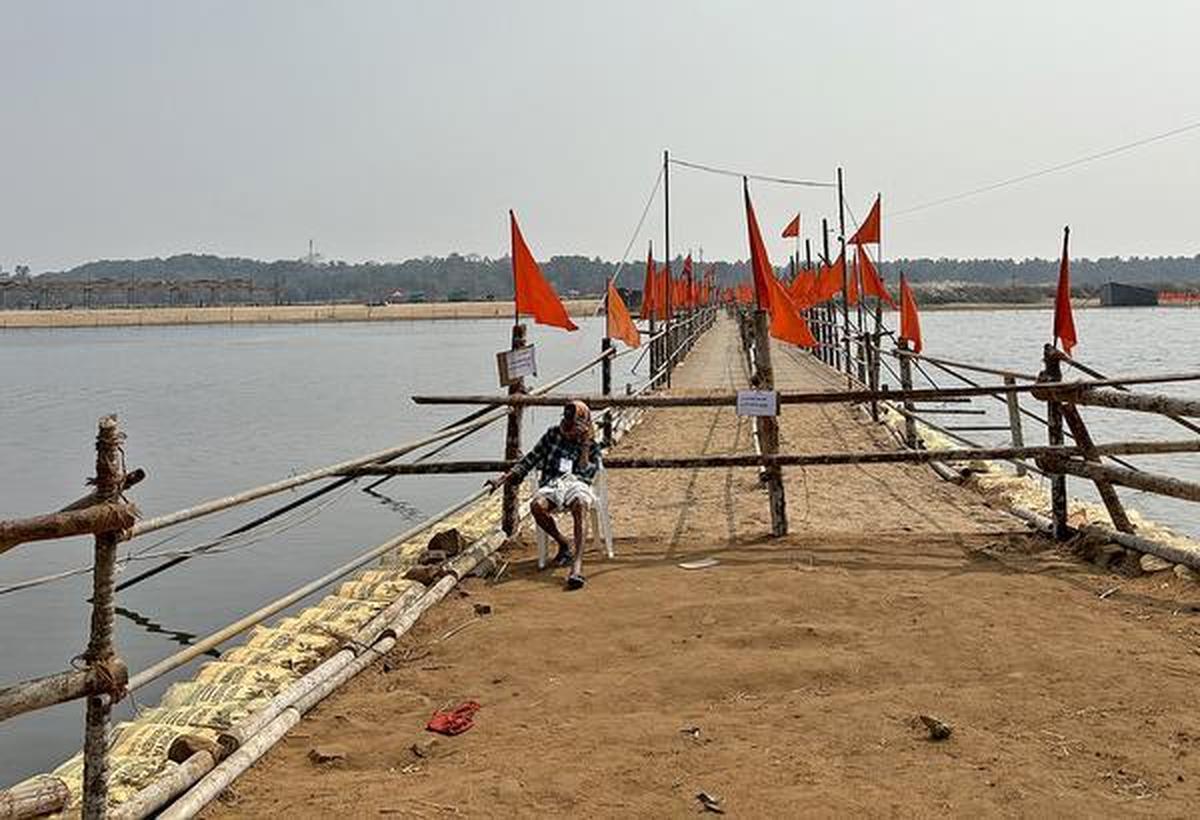
A temporary bridge constructed across the Bharathapuzha to reach the Maha Magham ritual venue is yet to open.
| Photo Credit:
Sakeer Hussain
The Bharathapuzha, a 209-km seasonal river swirling through central Kerala, has for centuries been the heartland of rice cultivation and spice production. Notably, during the Chera dynasty, the river’s navigability brought wealth and cosmopolitanism to the Malabar coast, connecting the Ghats with the Arabian Sea and facilitating the export of spices, ivory, and gems to international ports. Beyond commerce, some of Kerala’s most revered artistic and socio-cultural heritage owe their provenance to the Bharathapuzha.

The river is inextricably bound to Kerala’s Hindu faith, with its waters integral to salvation rituals such as pitru tarpana. Hundreds of temples dot the river’s littoral shelf, which believers view as sacred as Kashi. This spiritual ecosystem, sustained by the river’s flow and sanctity, is what lends Thirunavaya’s selection for the Maha Magha such historic gravity.
However, the deep channels of the Chera era have become skeletal sandbars. Bharathapuzha now survives on seasonal rains declining at 2.9 mm per year, with severe droughts, shortened bursts of rainfall, and floods. Today, this precarious life force sustains nearly 4 million Keralites within its 6,186 km² basin, where 493,064 hectares of agriculture depend entirely on the river.
Research indicates a consistent decline in its baseflow, the underground water that keeps a river alive during dry months. The Central Groundwater Board (2017) reported Bharathapuzha’s basin as “overexploited” due to indiscriminate sand mining, waste dumping, unscientific construction, and deforestation. And as water volume shrinks, toxin concentration rises.
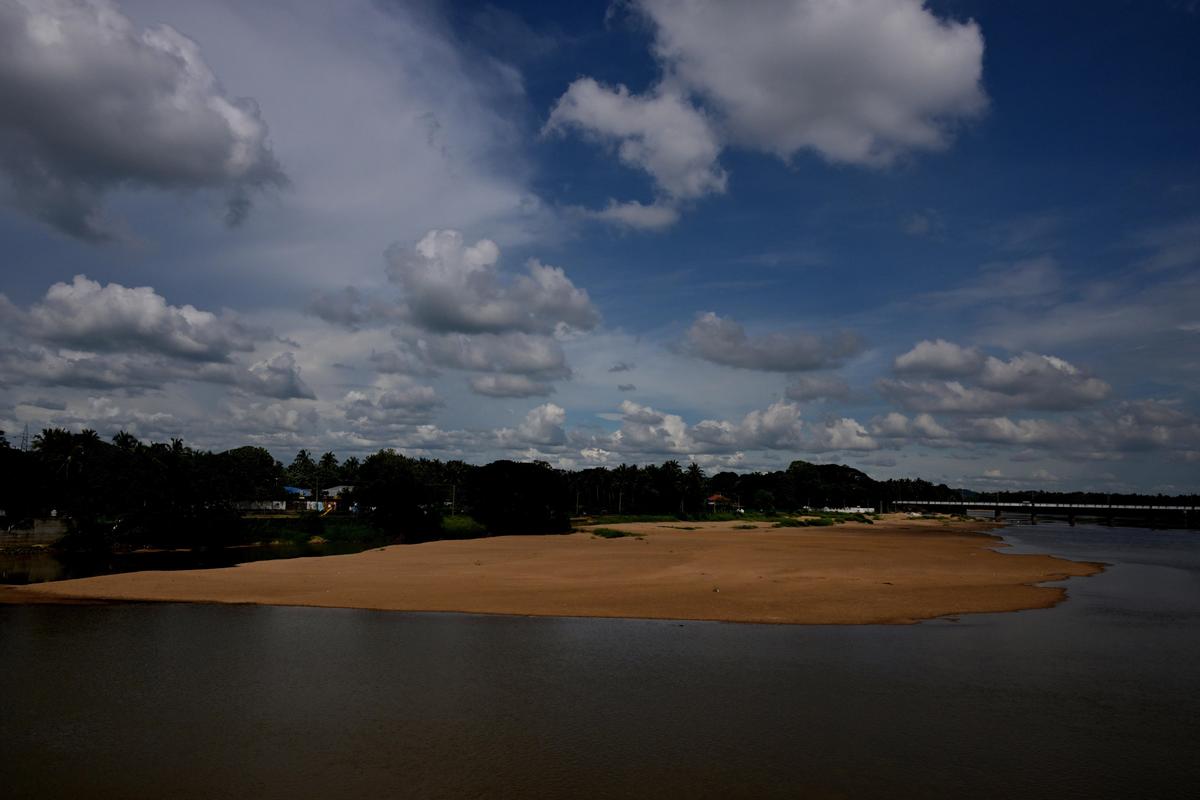
The Bharathapuzha (file image)
| Photo Credit:
K K Mustafah
During the 2019 Kumbh Mela, biological oxygen demand at Kuresar Ghat ranged from 2.5 to 8.6 mg/L, exceeding the 3 mg/L limit. Faecal coliform levels reached nearly 10 times the safe limit. Despite extensive government efforts, the Ganga’s water quality during Kumbh was unsuitable for public use and did not improve afterwards. These figures represent the impact of a monumental gathering on a large river with excellent dilution capacity. The Ganga, for all its resilience, struggles to recover from these periodic onslaughts. The Bharathapuzha has no such advantages.
In January and February, the Bharathapuzha is largely a series of stagnant pools connected by minimal current. When thousands of pilgrims enter stagnant water for ritual bathing, dissolved oxygen plummets as organic matter (skin cells, oils, bacteria) accumulates faster than it can be dispersed. Ritual offerings introduced into warm, slow-moving water cause algal blooms which deplete oxygen, triggering hypoxic mass killings of aquatic biodiversity (such as from garbage accumulation in Ponnani, May 2025).
Religious gatherings are important expressions of faith and cultural identity. Hindu philosophy has long held rivers as sacred, but respect for tradition and reverence for rivers now seem contradictory. Bureaucratic chaos has erupted days before thousands converge at Thirunavaya, but environmental safeguards are yet to be discussed. Ecological impact assessments, waste management plans, or guidance on preventing pollution spikes from both organisers and the government are absent. The recent stop memo controversy demonstrates performative activism rather than proactive environmental planning.
Pollution hotspot
In 2019, Friends of Bharathapuzha’s audit identified Thirunavaya as a pollution hotspot for untreated urban sewage. Five years later, has much changed? Have organisers coordinated with environmental groups to develop post-event restoration protocols? Have they studied the failures of religious gatherings in the north to avoid replicating them in Kerala? If there is one unifying principle that transcends religion and politics in Kerala, it should be this: the Bharathapuzha sustains the land. Its decline threatens farmers, fishers, believers, and future generations equally. Safely undertaking cultural events requires environmental responsibility as a foundational principle, not an afterthought. Before we celebrate cultural revival, we must ask: revival for whom? If the river dies, what exactly is it that we are reviving?
(The writer is a PhD student in Anthropology at the University of Oxford. Her research focusses on heritage preservation, traditional knowledge, and the sustainability of cultural practices in rural Kerala)
Published – January 22, 2026 11:21 am IST



