

By using this site, you agree to the Privacy Policy and Terms of Use.
Accept
India Times NowIndia Times NowIndia Times Now
Notification Show More
Font ResizerAa
  • Bharat Shreshtha Ratna Sanman
  • India News
  • Categories
    • Technology
    • Entertainment
    • The Escapist
    • Insider
    • Finance ₹
    • India News
    • Science
    • Health
Reading: Aditya-L1: IIA-NASA collaborate to record spectroscopic observations of a CME in visible wavelength range for very first time
Share
India Times NowIndia Times Now
Font ResizerAa
  • Bharat Shreshtha Ratna Sanman
  • India News
  • Categories
Search
  • Bharat Shreshtha Ratna Sanman
  • India News
  • Categories
    • Technology
    • Entertainment
    • The Escapist
    • Insider
    • Finance ₹
    • India News
    • Science
    • Health
Have an existing account? Sign In
Follow US

Home » Aditya-L1: IIA-NASA collaborate to record spectroscopic observations of a CME in visible wavelength range for very first time

India News

Aditya-L1: IIA-NASA collaborate to record spectroscopic observations of a CME in visible wavelength range for very first time

Times Desk
Last updated: November 9, 2025 5:51 am
Times Desk
Published: November 9, 2025
Share
SHARE


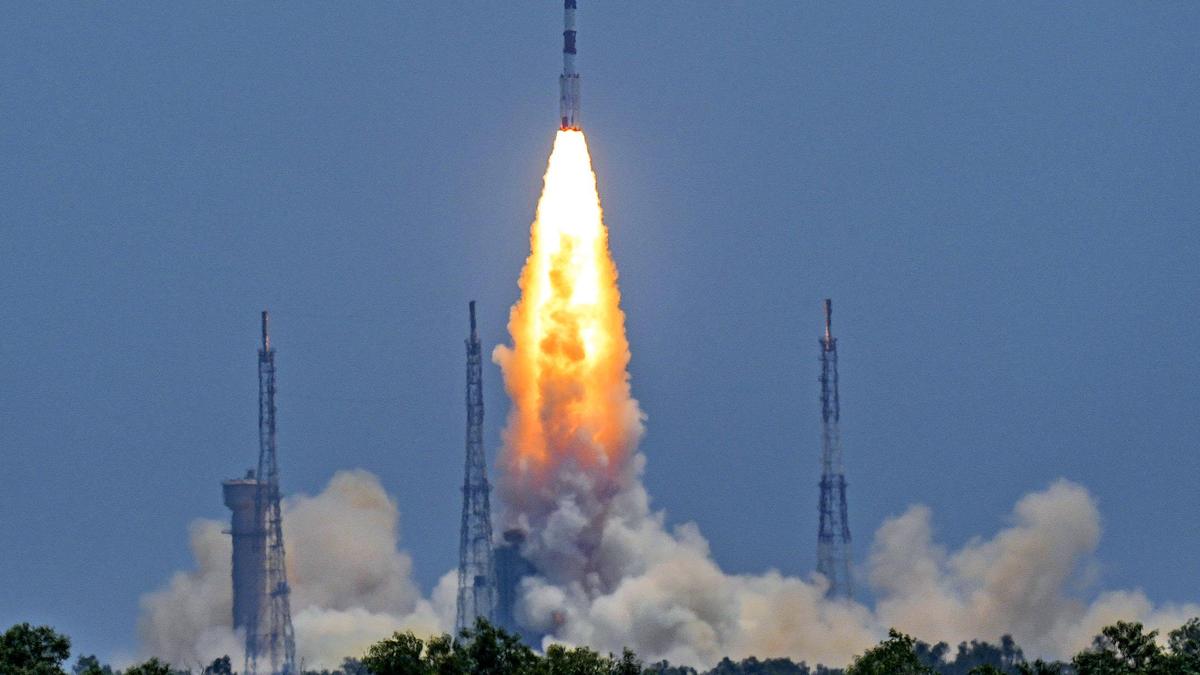
ndian Space Research Organisation's (ISRO) Aditya-L1, India's maiden solar mission, on board PSLV-C57 lifts off from the launch pad at Satish Dhawan Space Centre, in Sriharikota in 2023.

ndian Space Research Organisation’s (ISRO) Aditya-L1, India’s maiden solar mission, on board PSLV-C57 lifts off from the launch pad at Satish Dhawan Space Centre, in Sriharikota in 2023.
| Photo Credit: PTI

Using the VELC payload onboard India’s first dedicated space based solar mission, Aditya-L1, scientists at the Indian Institute of Astrophysics (IIA) along with NASA have collaborated to estimate the crucial parameters of a coronal mass ejection (CME), very close to its lift-off from the Sun.

Scientists associated with the project said that these are the very first spectroscopic observations of a CME in the visible wavelength range.

They said that the unique spectroscopic observations with the VELC has let them study the CMEs very close to the Sun’s visible surface itself, for the first time.

“In addition, it provides a sustained view of the Sun for 24 hours everyday because of being at the Sun-Earth Lagrangian L1 location where the Sun never sets,” they said.

Taking advantage of these, Dr. V. Muthupriyal (VELC Project Scientist) and her colleagues in the VELC payload operations centre at the IIA estimated the electron density, energy, mass, temperature and speed of a CME very close to the Sun.

Senior Professor at IIA and principal investigator of the VELC project, Prof. R. Ramesh, told The Hindu that the observations are by far the closest to the Sun where spectroscopic observations of a CME in the visible wavelength range have been obtained with a space coronagraph.

His team calculated that there are about 370 million electrons per cubic centimetre in the CME observed with the VELC.

The corresponding number for the non-CME corona near the Sun is much lesser, in the range 10 – 100 million electrons per cubic centimetre.

“The CME energy in the present case is approximately 9.4 * 1021 Joules. For example, the yield of the atomic bombs (nicknamed “Little Boy” and “Fat Man”) used on Hiroshima and Nagasaki are about 6.3 * 1013 Joules, and 8.8 * 1013 Joules, respectively. The mass in the CME is nearly 270 million tons. For comparison, the mass of the iceberg that sank the Titanic is estimated to be 1.5 million tons. The initial speed of the CME is 264 km/sec. The CME temperature is 1.8 million degrees on the Kelvin scale,” Prof. Ramesh said.

He also added that though there are observations of CMEs at comparatively larger distances from the Sun, with instruments other than the VELC, an understanding of the parameters of a CME in relation to how much is lost from the Sun during a CME per se is crucial, and the unique near-Sun spectroscopic observations with the VELC is precisely providing us the necessary data.

Prof. Ramesh added that with the Sun nearing the maximum activity phase of th ecurrent sunspot cycle 25 and with the VELC now stabilized in its operations, more massive and energetic eruptions from the Sun are expected to be observed with the VELC in the coming months.

Published – November 09, 2025 11:21 am IST


Source link

20 passengers burnt alive, 16 injured as bus catches fire in Jaisalmer; PM announces ex-gratia
Repeated disruptions of peaceful Sikh nagar kirtans in New Zealand deeply concerning: Sukhbir Badal
Steps into past: 1,500-year-old reservoir unearthed on Elephanta island
Tamil Nadu Assembly election 2026: K. Manivasan to be State’s Home Secretary
Taliban Minister calls for easing visa regime, enhanced trade
TAGGED:Aditya-L1 missionAditya-L1 mission ISROAditya-L1 mission NASA
Share This Article
Facebook Email Print
Leave a Comment

Leave a Reply Cancel reply

Your email address will not be published. Required fields are marked *

Follow US

Find US on Social Medias
FacebookLike
XFollow
YoutubeSubscribe
TelegramFollow

Weekly Newsletter

Subscribe to our newsletter to get our newest articles instantly!
[mc4wp_form]
Popular News
BusinessStartup

Gold, Silver Rates Today (October 17): MCX gold, silver prices hit record high ahead of Diwali | Check city-wise rates

Times Desk
Times Desk
October 17, 2025
‘Ladakh has changed, its people haven’t: Farhan Akhtar reflects on journey from Lakshya to 120 Bahadur
Did Samantha Ruth Prabhu, Raj Nidimoru get engaged in February? Internet tracks old pic with her wedding ring
Stray cattle menace in Chennai: Licensing, microchipping of cattle now made mandatory by Corporation
Congress leader Adhir meets PM Modi over attacks on Bangla-speaking migrants
- Advertisement -
Ad imageAd image
Global Coronavirus Cases

Confirmed

0

Death

0

More Information:Covid-19 Statistics
© INDIA TIMES NOW 2026 . All Rights Reserved.
Welcome Back!

Sign in to your account

Username or Email Address
Password

Lost your password?

