


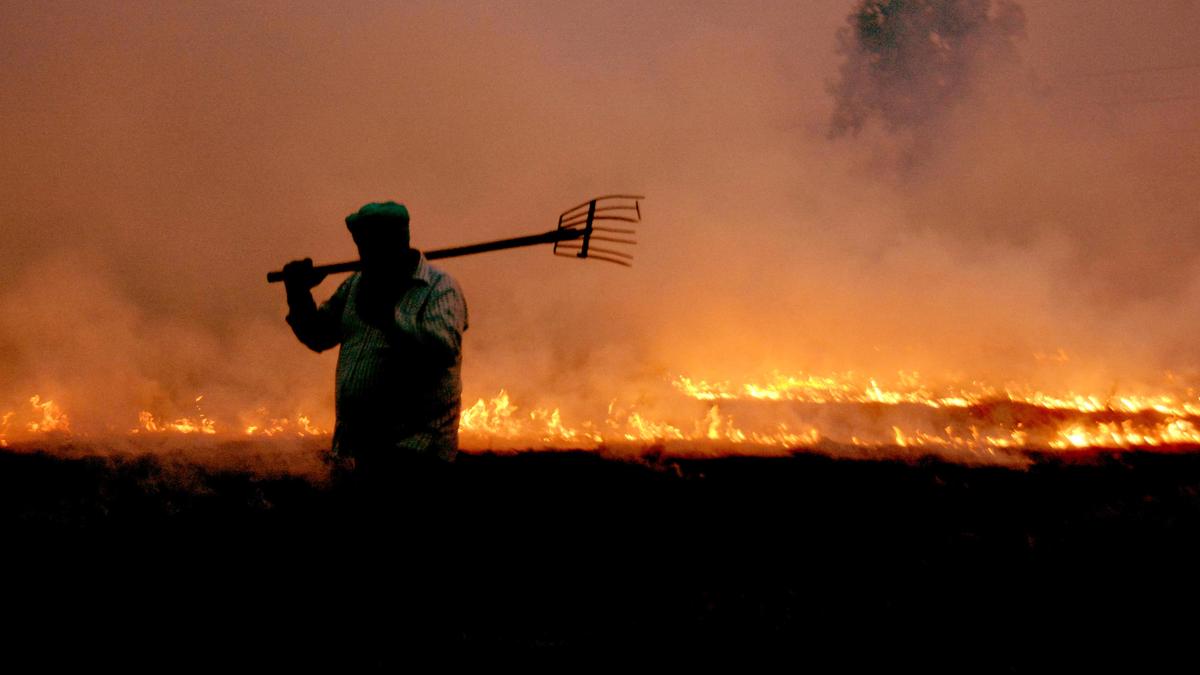
The first fortnight of November is historically when farm fires in Punjab peak and there very may well be a surge in burnt area. File
| Photo Credit: ANI
While instances of stubble burning in Punjab in October were at a five-year low, the area that was actually set afire in three major districts – Amritsar, Taran Taran and Ferozpur – was likely 20% less than last year, according to data sourced by The Hindu from a satellite-imagery firm and a senior official formerly with the Punjab Pollution Control Board. However, the first fortnight of November is historically when farm fires in Punjab peak and there very may well be a surge in burnt area.
The government regularly shares daily data on the fire-count but does not disclose burnt area. The link between fire counts and burnt area is significant for an accurate picture on efforts to curb farm fires, that in previous years, have contributed as much as 35% of the daily winter pollution load in Delhi, but can also decline to single digits depending on wind direction.

Last November, The Hindu reported – triggering the Supreme Court to order increased scrutiny – that the Punjab government’s claims of a reduction in farm fires, by publicising only fire counts caught on satellite, did not capture reality. The area actually burnt in Punjab had increased in 2023 (19.1 lakh hectares) compared to 2022 (15.4 lakh hectares). This was likely due to farmers burning stubble after satellite-passes to avoid detection. In 2024, the burnt area figures were nearly the same as 2023, at 19.4 lakh hectares, as The Hindu reported last month.
This year, satellite imagery of farm fires over Punjab only began emerging around October 10 – almost a month-long delay – compared to previous years. This was due to heavy rain and flooding during most of September, contributing to a delayed harvest.
Between October 13 and October 28, the three districts were responsible for 515 fire events detected by satellite, about 55% of the 933 such events in the state.

In that period, 2.46 lakh hectares were burnt in these districts, according to an analysis shared with The Hindu by Noida-based Suhora Technologies, a space-analytics company with expertise in using satellite imagery for a variety of applications. “Geographically, the fire incidents began in a localised pattern, initially concentrating in tehsils like Ajnala (Amritsar) and Khadur Sahib (Tarn Taran), before rapidly expanding and intensifying. The main areas of focus throughout the monitoring period included Majitha, Baba Bakala, Amritsar-II, Khadur Sahib, Tarn Taran, and Ajnala,” they said in their report. They used imagery from the Sentinel-2 Multi Spectral Instrument (MSI) for their images. Located on the European Space Agency’s Sentinel-2 satellite, the MSI is used to identify and map burnt areas by analysing how different wavelengths of light are reflected from a fire-affected landscape.
Krunesh Garg, who had served as the Member Secretary, Punjab Pollution Control Board, until September 2025 and has for years monitored and implemented measures to address stubble burning, told The Hindu that data with him showed ”the three districts at the same time last year reported 3.15 lakh hectares of burnt area”. “If it is indeed 2.46 lakh hectares, that is a reduction and is certainly a positive sign…it shows that measures implemented in the last five years have started to show results,” he added. He said that Amritsar and Taran Taran belt (north-east Punjab) typically saw fires start early and conclude by October-end. “Irrespective of the floods, I believe that whatever burning has to have happened in those regions has already concluded,” he noted.
The Hindu couldn’t establish what proportion of cultivated area in the three districts of Amritsar, Taran Taran and Firozpur have been harvested. In the week from October 28 to November 4, fire counts have sharply spiked from 993 to 2,839 – nearly three times higher than the cumulative October figures. Still, this is nearly half of the fire count logged at same time last year and about a fifth of figures from 2023. The spike was attributed to the window for sowing wheat – the rabbi crop – fast closing and available till November 15.

However whether this has meant a notable reduction in burnt area remains to be seen. An official in the Central Pollution Control Board told The Hindu, while declining to be identified, that “early reports” suggested a reduction in burnt area compared to last year.
Environment Minister Bhupendra Yadav said at a briefing earlier this week that a “comprehensive report” would be available later this month but that several teams from the Centre were closely coordinating with the Punjab government to check stubble burning. The total area under paddy cultivation this year was 32 lakh hectares, according to the Punjab Agriculture Department, of which about a third had been harvested.
Published – November 05, 2025 10:50 pm IST



