


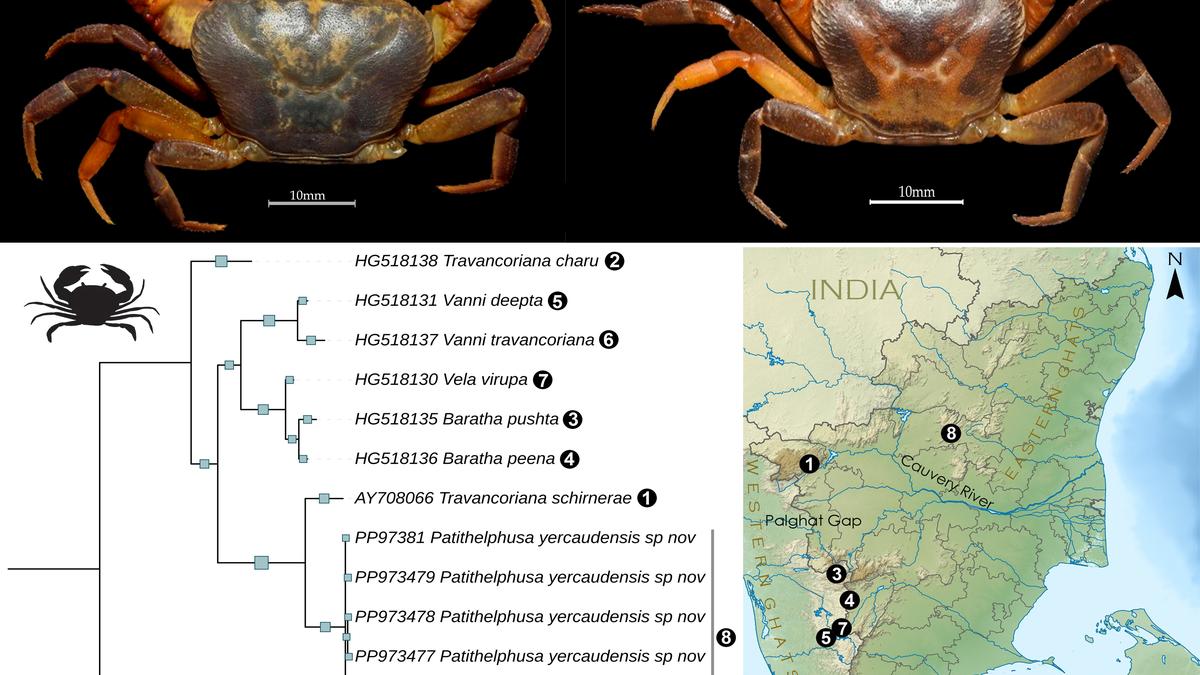
The newly described genus, Patithelphusa, and its species, Patithelphusa yercaudensis, were discovered during a zoological survey by researchers from the Zoological Survey of India (ZSI), Kolkata, and Pukyong National University, South Korea
| Photo Credit: Special Arrangement
Scientists have identified a new genus and species of freshwater crab from the Shevaroy Hills in Yercaud, Salem district, adding to India’s growing record of freshwater crustacean diversity.
The newly described genus, Patithelphusa, and its species, Patithelphusa yercaudensis, were discovered during a zoological survey by researchers from the Zoological Survey of India (ZSI), Kolkata, and Pukyong National University, South Korea. The study was led by Santanu Mitra and Shibananda Rath from the ZSI, along with researchers Hyun-Woo Kim and Shantanu Kundu.
The genus has been named in honour of Sameer Kumar Pati, a noted Indian taxonomist who has made significant contributions to the study of freshwater crabs.
The specimens were collected from a muddy microhabitat beside a rocky stream at Manjakuttai in the Shevaroy Hills, located over 1,400 metres above sea level. The crabs were preserved and examined at the ZSI’s Crustacea Division, where detailed morphological studies were carried out, followed by molecular analysis using mitochondrial DNA sequences.
Published in the international zoological journal ZooKeys, the study notes that Patithelphusa yercaudensis is genetically and morphologically distinct from its closest known relatives. It shows a genetic divergence of 9.66% from Travancoriana schirnerae, a species found in southern India. Morphologically, it can be identified by its broader carapace, distinct triangular lobes, and unique features of the male reproductive structures, which differ from other genera such as Baratha, Vanni, and Vela.
The study suggests that the crab’s evolution may have been shaped by the topographical isolation of the Shevaroy Hills, separated from nearby ranges by deep valleys and the Cauvery River system. These natural barriers likely restricted gene flow, allowing crab populations to evolve independently over time. Such high-altitude habitats in the Eastern Ghats may serve as refuges for endemic species that have adapted to specialised environments.
The discovery highlights the ecological significance of the Eastern Ghats, a region that remains comparatively less studied than the Western Ghats. The researchers note that the diversity of freshwater crabs in the Indian subcontinent is still being uncovered, with many species known only from limited localities.
With this discovery, the number of freshwater crab species recorded from India rises to 112, belonging to 31 genera under the family Gecarcinucidae, the study notes. India accounts for nearly 10% of the world’s known freshwater crab species, many of which are restricted to small, localised habitats.
The authors say that continued surveys and documentation are needed to better understand the diversity of freshwater crabs in peninsular India. They add that protecting hill-stream ecosystems is crucial, as these habitats face increasing pressures from tourism and land-use changes in regions such as Yercaud.
Published – November 01, 2025 05:15 pm IST



