


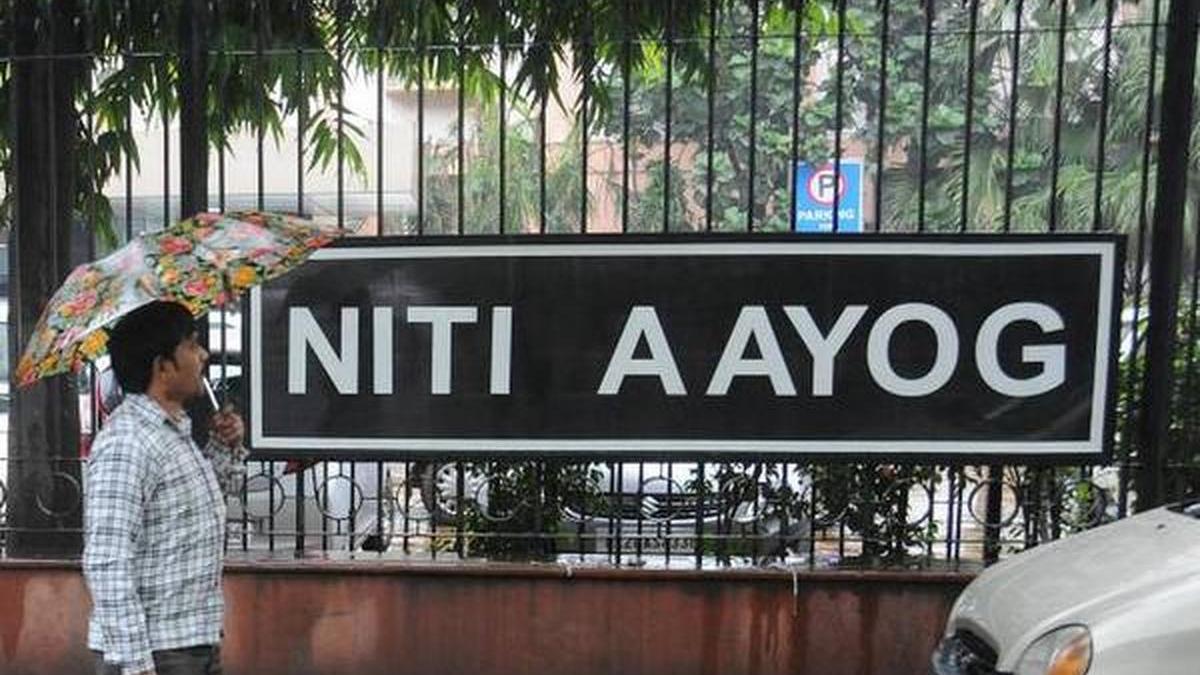
Image for the purpose of representation only.
| Photo Credit: File
A report released here on Tuesday by the Niti Aayog on ‘India’s Services Sector: Insights from Employment Trends and State-Level Dynamics’ has revealed that while services remain the mainstay of India’s employment growth, they face a number of challenges. Employment generation is uneven across sub-sectors, informality remains widespread, and job quality continues to lag behind output growth, the report said. “Gender gaps, rural–urban divides, and regional disparities underline the need for an employment strategy that integrates formalisation, inclusion, and productivity enhancement at its core,” it said.
Over the past three decades, services sectors have expanded rapidly around the world. The report said India’s transition has been slower. “The services’ share of employment grew from 22.1% in 1992 to 31.0% in 2022, an increase of only 8.9 percentage points, much below the global average,” the report noted citing World Bank figures. In 2023-24, out of approximately 634 million workers, agriculture remained the largest employing sector with 292 million people working, followed by services (188 million) and industry (153 million). “Agriculture continues to dominate numerically, even as its share in value added has sharply declined. Services have emerged as the second-largest employer, with rising job numbers alongside their growing contribution to national income. Industry, while critical for investment and output, engages a comparatively smaller share of workers,” the report said.
Between 2017-18 and 2023-24, the share of services in rural employment declined from 19.9% to 18.9%. In urban areas, the services share increased from 59.1% to 60.8% over the same period. During the period, male participation in services increased from 32.8% to 34.9%, while female participation declined from 25.2% to 20.1%. “Over the same period, agriculture became increasingly female-dominated, with women’s share in agriculture rising from 57.0% to 64.4%, while men’s share fell from 40.2% to 36.3%,” the report said.
In urban areas, 61% of men are employed in services, while 60% of women are employed in the sector. “This suggests that while urban women have far greater access to services than rural women, their sectoral spread remains narrower than that of men,” the report noted. “Rural women remain largely excluded from the services sector, making up just 10.5% of its workforce, less than half the share of rural men [24%],” it said.
In 2023-24, over half of all service workers (96 million) were employed in regular wage or salaried roles, the highest across sectors. Eighty-five million workers (45%) were self-employed, many of whom operate as small shopkeepers, drivers or own-account service providers. “The youth cohort [15-29 years] is underrepresented, pointing to barriers to entry into regular wage work, insufficient skilling, poor job readiness, and weak school-to-work transitions. Meanwhile, the share of older workers [45+] declines sharply, with regular wage jobs falling from 10% in the 55–59 group to just 1% beyond age 65. Only a small fraction continues in self-employment, highlighting limited options for retention,” the report added.
Published – October 28, 2025 09:46 pm IST



