


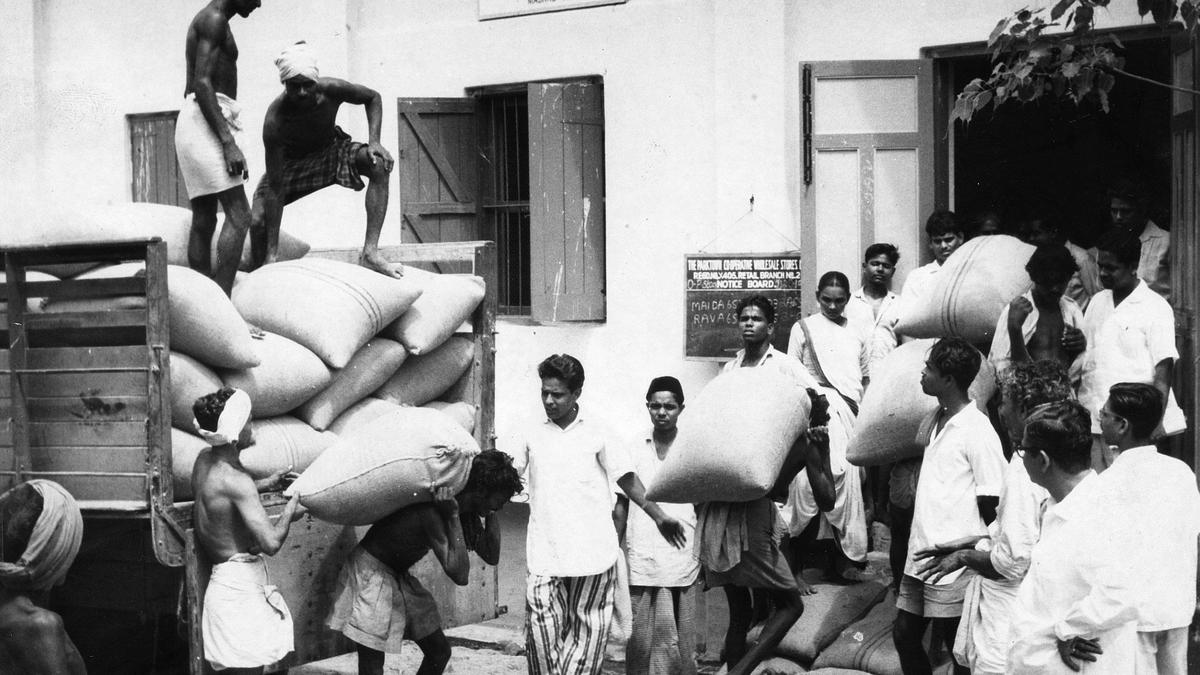
The situation of rice availability in Tamil Nadu started becoming serious even in 1964.
| Photo Credit: The Hindu Archives
Back in the mid-1960s, Tamil Nadu had faced a spell of acute shortage of rice. Politically, the rice problem of the 1960s had cost the Congress dearly as the party was thrown out of power during the 1967 Assembly election. Since then, the party has not been able to get back to power. The then Chief Minister M. Bakthavatsalam is still blamed for the way his regime had handled the crisis.
Even as the country, since the late 1950s, began implementing well-meaning suggestions of the Ashok Mehta panel that went into causes of price rise of foodgrains during 1956 and 1957, it encountered back-to-back drought in 1965 and 1966. The production of rice in the two years went down by about 20%, compared to 1964-65, when the country produced 39 million tonnes. Foodgrains were still imported from the international market to meet the shortfall, keeping in mind the scarcely available foreign reserves. While Myanmar and Thailand were among the supplier-countries of rice to India, the United States, under the Public Law (PL) 480 agreement, supplied wheat and milo to the country.
As a sequel to the Ashok Mehta committee’s findings, fair price shops were established and the system of rice procurement of rice was put in place. Besides, Tamil Nadu along with Andhra Pradesh shared the responsibility of finding the rice required for distribution in Kerala, which was not one among the major rice-producing States. Tamil Nadu’s production was stagnating at about 3.5 million tonnes with the yield of 1.4 tonnes per hectare. High yielding variety seeds were introduced only in 1965. Moreover, more and more people were switching over to rice from millets, increasing the stress on the system that was struggling to meet even the existing demand for rice. Even by the mid-1960s, the State had reached almost the saturation point with regard to the development of its surface water resources.
The situation of rice availability in Tamil Nadu started becoming serious even in 1964. The Hindu, in a news report on October 7, 1964, stated that “Thanjavur district, the ‘rice bowl’ of the Madras State [which was how the State was called then], has been experiencing very great difficulty for the last six weeks in meeting the local demands for rice and daily one can see long queues in every town and village in the district waiting for hours to get their daily quota.”
The damage to the crop raised during the Samba cultivation season in 1963; the government’s practice of fixing rice price prior to the determination of paddy price; millers, who were given the task of purchasing paddy on behalf of the government, viewing the procurement system as one that “killed their initiative and incentive”; lack of stocks available with the millers during lean months and “mass export” of rice to Kerala at “fancy prices” were among the reasons cited. [The Tamil Nadu Civil Supplies Corporation, the State government’s procurement agency, came into being only in 1972].
The authorities had then launched punitive action against law violators. It was then that the State government began considering the question of introducing family cards to consumers to draw their supplies of foodgrains in the capital and other important cities of the State. Later that month, in the Assembly, the Congress government, led by Bhaktavatsalam, had received flak from the DMK and the Communist Party of India (CPI), which had criticised it for being “inefficient” in handling the issue.
In 1965, the War with Pakistan forced the Union government and State governments to review the foodgrains position, according to the then Chief Minister Bhaktavatsalam in his memoir published in 1971. Due to the insistence of the then Prime Minister Lal Bahadur Shastri and Union Food Minister C. Subramaniam, the statutory rationing system was introduced in Madras city and Coimbatore, even though the Chief Minister felt that the situation could be managed without rationing. The next year – 1966 – witnessed an “unprecedented drought and shortage,” Bhaktavatsalam states. It was in this year that the controversy over rice through the public distribution system got aggravated, even though the Chief Minister had explained in detail how his government managed the situation amid severe constraints. He contends that despite the fall in production and procurement during 1966, the quantity of rice distributed to the people did not go down.
However, C. Subramaniam, in his memoir (published in 1995), blames his party’s government in the State for “bungling” in the distribution of foodgrains, which were “more than adequate.” Pointing out that “there were long queues before the fair price shops which, in some places, stretched one mile long,” Subramaniam adds that “on the eve of the [Assembly] elections, the supplies were reduced, creating a panic situation throughout the State.”
Regardless of the correctness or otherwise of either of the versions, the episode of rice shortage taught a bitter lesson to the Congress. It remains educative for Bhaktavatsalam’s successors.
Published – October 29, 2025 05:30 am IST



